The Cruciferous Compound That Isn't Sulforaphane
Broccoli gets all the cruciferous-vegetable attention for one compound — cauliflower and cabbage carry a different one entirely.
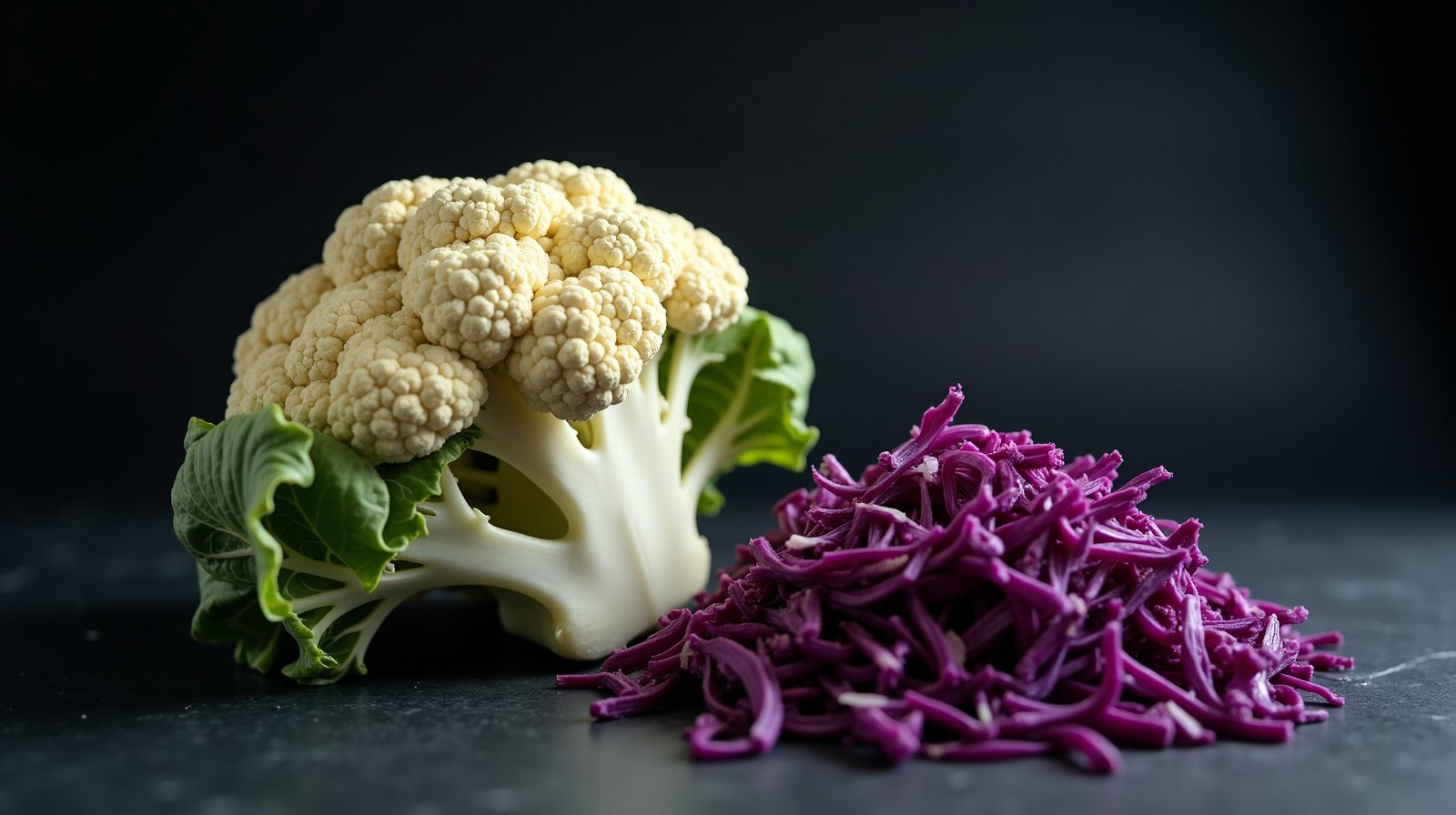
Cruciferous vegetables are usually discussed as one category with one headline compound, sulforaphane, thanks to broccoli's reputation. But cauliflower and cabbage are rich in indole-3-carbinol (I3C), which the body converts to DIM (diindolylmethane) — a separate compound working through a completely different mechanism.
Key Findings
- I3C/DIM works through a completely different pathway than broccoli's sulforaphane
- It measurably shifts estrogen metabolism toward a less-potent form
- Research doesn't show the popular DIM supplement outperforming whole-food I3C
- Cauliflower, cabbage, and Brussels sprouts all count — not just broccoli
A different pathway entirely
Unlike sulforaphane's detox-enzyme activation pathway, I3C/DIM shifts estrogen metabolism toward a less-potent form — raising the ratio of 2-hydroxyestrone to 16α-hydroxyestrone in the body.1 That's a distinct hormonal mechanism, relevant to estrogen-sensitive conditions, that sulforaphane doesn't address.
I3C vs. the DIM supplement
Human trials on I3C supplementation show measurable, reproducible shifts in these estrogen metabolite ratios. Comparative research finds significantly more clinical trial data exists for I3C specifically than for DIM, the supplement form it converts into — and current evidence doesn't show DIM providing additional benefit over I3C itself, despite how heavily DIM is marketed as a standalone product.2
Why this changes the standard advice
"Eat more broccoli for sulforaphane" is common, well-supported advice — but it doesn't cover I3C at all. Cauliflower, cabbage, and Brussels sprouts are all legitimate sources of this separate compound family.
The practical takeaway
- Variety across cruciferous vegetables — not just broccoli — covers both mechanisms
- Current evidence doesn't support DIM supplements as superior to whole-food I3C sources
- This is mechanistic and hormonal-marker research, not a treatment claim for any specific condition
Sources
- "Indoles Derived From Glucobrassicin: Cancer Chemoprevention by Indole-3-Carbinol and 3,3'-Diindolylmethane." PMC. ncbi.nlm.nih.gov
- "A review of the clinical efficacy and safety of cruciferous vegetable phytochemicals." PubMed. pubmed.ncbi.nlm.nih.gov